Short answer: not on its own. Most people stand with some anterior pelvic tilt, and research comparing people with and without lower back pain hasn't found that the amount of tilt in standing separates the two groups. So if you've been told your tilted pelvis is the reason your back hurts, it's worth taking a step back.
That doesn't mean your pelvis is irrelevant. In our experience, how your pelvis moves, and where it sits relative to the rest of your body when you walk, bend, sit and lift, tells us far more than a single standing snapshot. That's what this post is about.
What Is Anterior Pelvic Tilt?
Anterior pelvic tilt means the front of your pelvis is rotated forward and down, with the back of the pelvis rising up. It usually comes with a deeper curve in the lower back and, often, a waistband that sits lower at the front than at the back.
It's often confused with an anterior pelvic shift, where the whole pelvis sits forward of the ankles rather than just rotating. The two often show up together, and the difference matters for what you do about it. We explain it in more detail in Anterior Pelvic Tilt or Shift? Why It Matters for Pain and Posture.
What Does the Research Say?
A few points are worth knowing:
- Some anterior tilt is normal. Studies measuring people without pain find that most stand with a degree of anterior tilt, and the range from person to person is wide.
- Pelvic shape varies. The bones themselves differ between people, so a pelvis can look tilted on a quick visual check when it's partly just how that person is built.
- Standing tilt doesn't separate people with and without back pain. A 2014 systematic review and meta-analysis found no meaningful difference in lower back curve or standing pelvic tilt between the two groups. What did differ was movement: people with back pain tended to have less range of motion in the lower back.
That last finding lines up with what we see in the clinic. The problem is rarely the position you're standing in for a photo. It's what happens when you start moving.
So What Actually Matters for Your Back?
When we assess someone with lower back pain, we're less interested in labelling their pelvis and more interested in questions like these:
- Can the pelvis move, or is it stuck? A pelvis that stays tilted (or flattened) whatever you're doing leaves the lower back to absorb movement it should be sharing with the hips and upper back.
- Is the pelvis sitting forward of the feet? A forward shift often pushes the lower back into extension and takes support away from the glutes and trunk. Correct the shift and the tilt often looks very different.
- What's happening above and below? Rib cage position, how the feet take load and how the hips extend when you walk all influence what the pelvis does.
- How does it behave under load? Bending to pick something up, getting out of the car, running. Pain often shows up in these moments rather than when you're standing still.
Pain is also influenced by more than mechanics. Sleep, stress, activity levels and general health all play a part, and a good assessment keeps that in view rather than blaming everything on posture.
Why Tilt Exercises Often Don't Fix It
The standard advice for anterior pelvic tilt is to stretch the hip flexors, strengthen the glutes and abs, and practise tucking the pelvis under. None of those is harmful in itself, but there are a few common problems:
- They treat the tilt as the problem. If the real driver is a forward shift or how you load through your feet, drilling a tucked pelvis can miss the point, or just swap one stuck position for another.
- They don't carry over. Lying on your back doing a glute bridge doesn't teach your pelvis what to do when you walk, run or lift.
- Stretching rarely changes position on its own. Muscles that feel tight are often working hard to hold you up. We cover this in Why Stretching Isn't Fixing Your Tight Muscles.
Our focus is on helping the pelvis find the right position for the task you're doing, whether that's standing, walking, bending or running, and building the strength to hold it there.
What This Looks Like in Practice
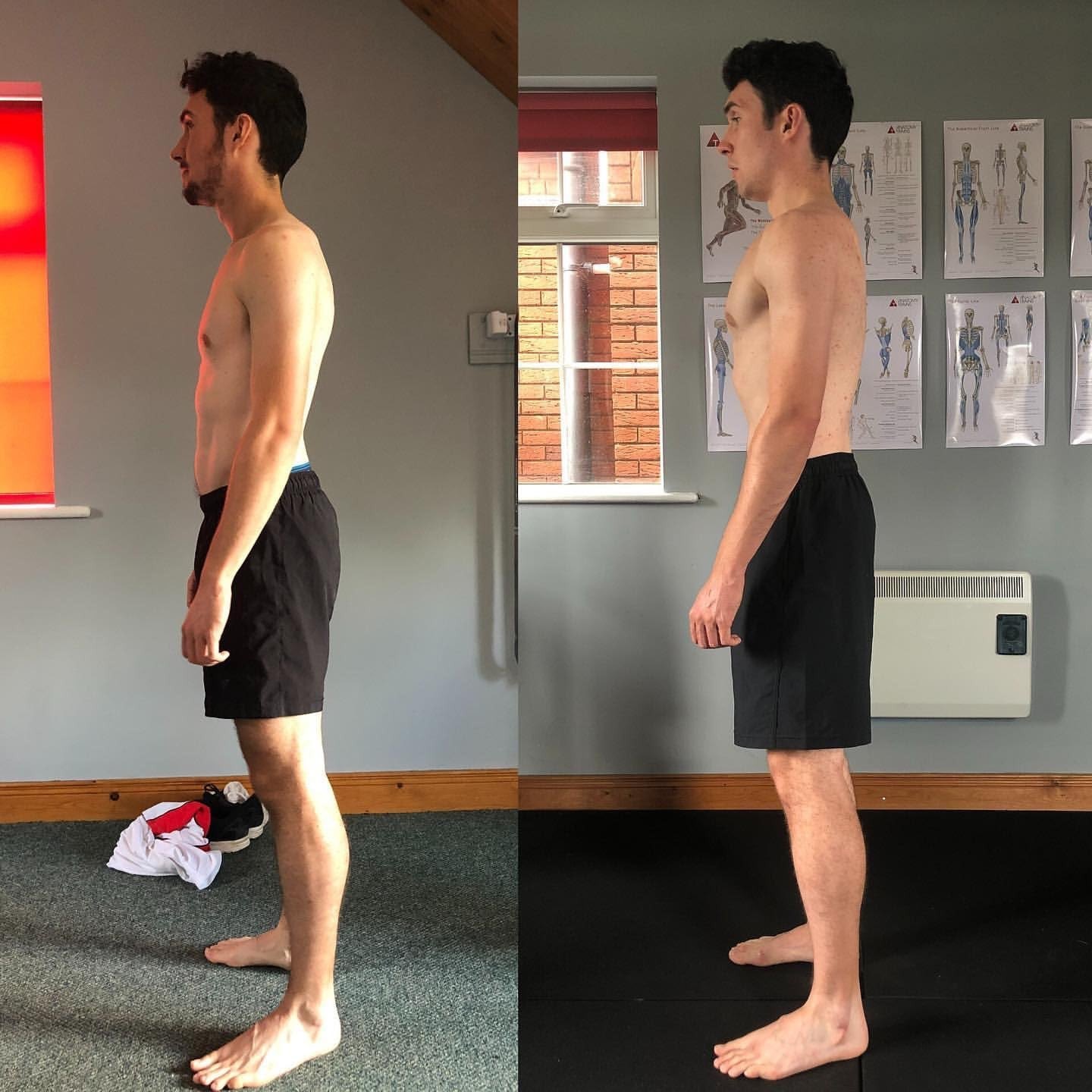
Shane is a long-distance runner who came to us with lower back pain. In his before photo (left), his pelvis sits forward of his feet, with a deeper curve in his lower back and a rounded upper back. Rather than drilling pelvic tilt exercises, we worked on how his whole body was organised when standing, walking and running.
Eleven months later (right), he's far more stacked: ribcage over pelvis, pelvis over ankles. Shane's lower back pain was gone, and he set a new 5,000m personal best along the way. Both photos show his relaxed standing posture.
Every client is different, and changes like this come from consistent work over months, not weeks.
How We Assess Pelvic Position at FP Dublin
Your first session includes a postural analysis and a video gait analysis, so we can see how your pelvis behaves when you stand and when you walk, not just one or the other. We can also add a 3D posture scan, which gives us measurements of how your pelvis and spine are positioned and a baseline to compare against when you're rescanned.
From there we build a programme around what we find. If your back pain is linked to walking, our post on lower back pain when walking goes into more detail.
When to See a Doctor First
Most lower back pain isn't serious. But get checked urgently by your GP or an emergency department if your back pain comes with numbness around your genitals or buttocks, new problems controlling your bladder or bowel, weakness in your legs, a fever, unexplained weight loss, or if it started after a fall or injury.
Frequently Asked Questions
Is anterior pelvic tilt the cause of my back pain?
It may be part of the picture, but it's rarely the whole story. Research hasn't found that the amount of tilt in standing separates people with and without back pain, so we look at how your pelvis moves and how the rest of your body is organised around it.
Can you fix anterior pelvic tilt?
Pelvic position can change with the right training, but the goal isn't a "perfect" angle. It's a pelvis that can move into the right position for what you're doing. How long that takes varies from person to person.
Should I stop doing glute bridges and hip flexor stretches?
Not necessarily. They're not harmful, but on their own they rarely change how you stand and move. They work best as part of a programme built around your assessment.
Do I need a scan to know if I have anterior pelvic tilt?
No. A good visual assessment will show it. A 3D scan adds measurements we can track over time.
If your lower back keeps flaring up and you've been told your pelvis is to blame, an assessment is the best place to start. We'll show you what your pelvis is actually doing and what we'd work on. We see clients from across Dublin and beyond at our clinic in Donabate, 10 minutes from Dublin Airport. You can read more about how we help with back pain.